Edgar Award Nominee—Best Fact Crime
Mccavity Award Nominee—Best Mystery Nonfiction
One of CrimeReads’ Best True Crime Books of the Year
American Masters, PBS—Essential Culture Reads
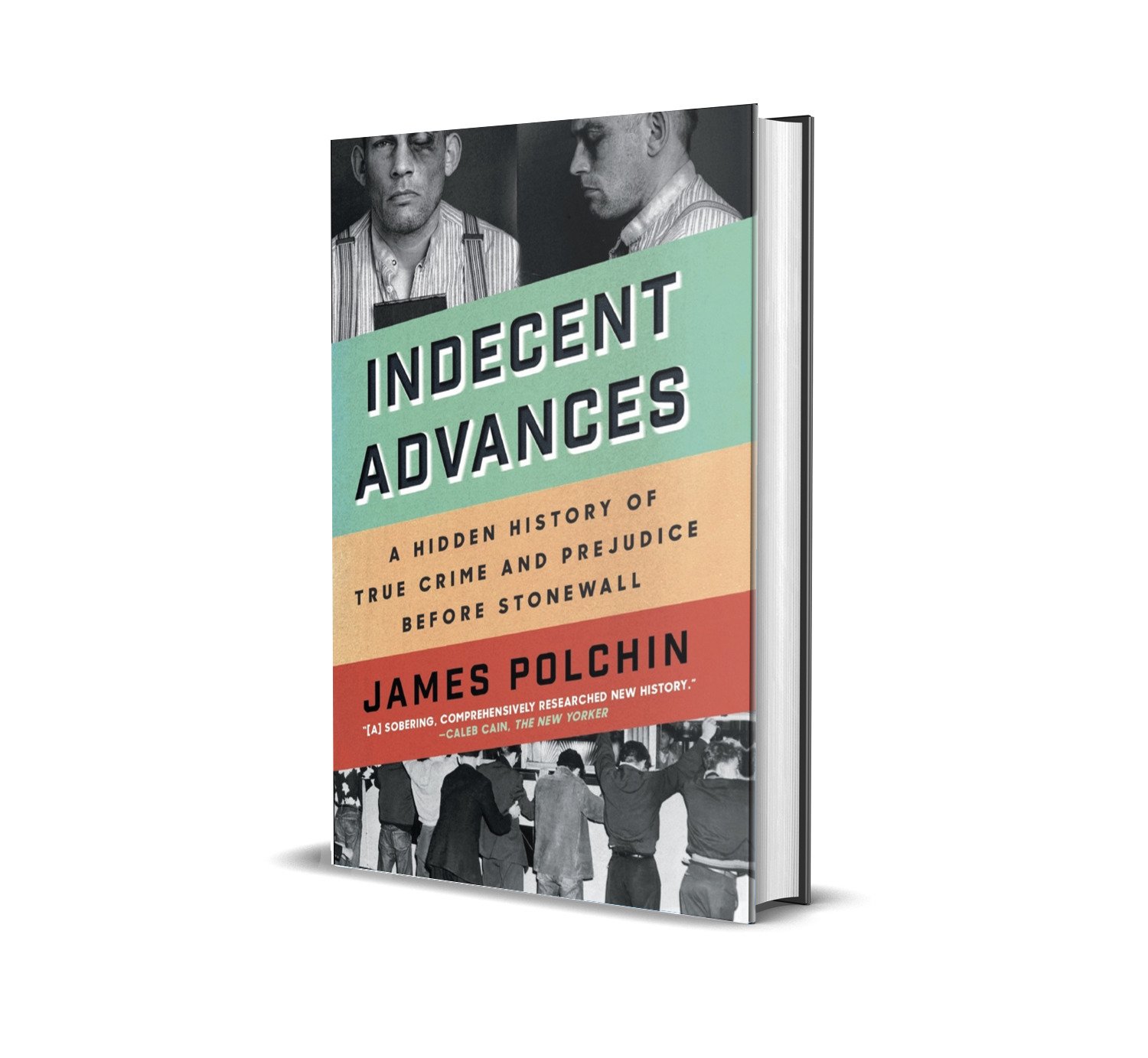
"A grisly, sobering, comprehensively researched new history"
The New Yorker
"Fascinating"
The New Republic
"Fast-paced, meticulously researched, and thoroughly engaging"
San Francisco Chronicle
"Delight true crime fans"
Publishers Weekly
“Enlighteningly provocative"
Kirkus Reviews
"Polchin masterfully weaves brutal true crime research with critical analysis of the social history"
CrimeReads
"A significant contribution to queer history"
Los Angeles Review of Books
"Perfectly blends true crime and the history of discrimination"
Library Journal
"Rescues a significant gay history and goes a long way toward clarifying why we fight"
Lambda Literary
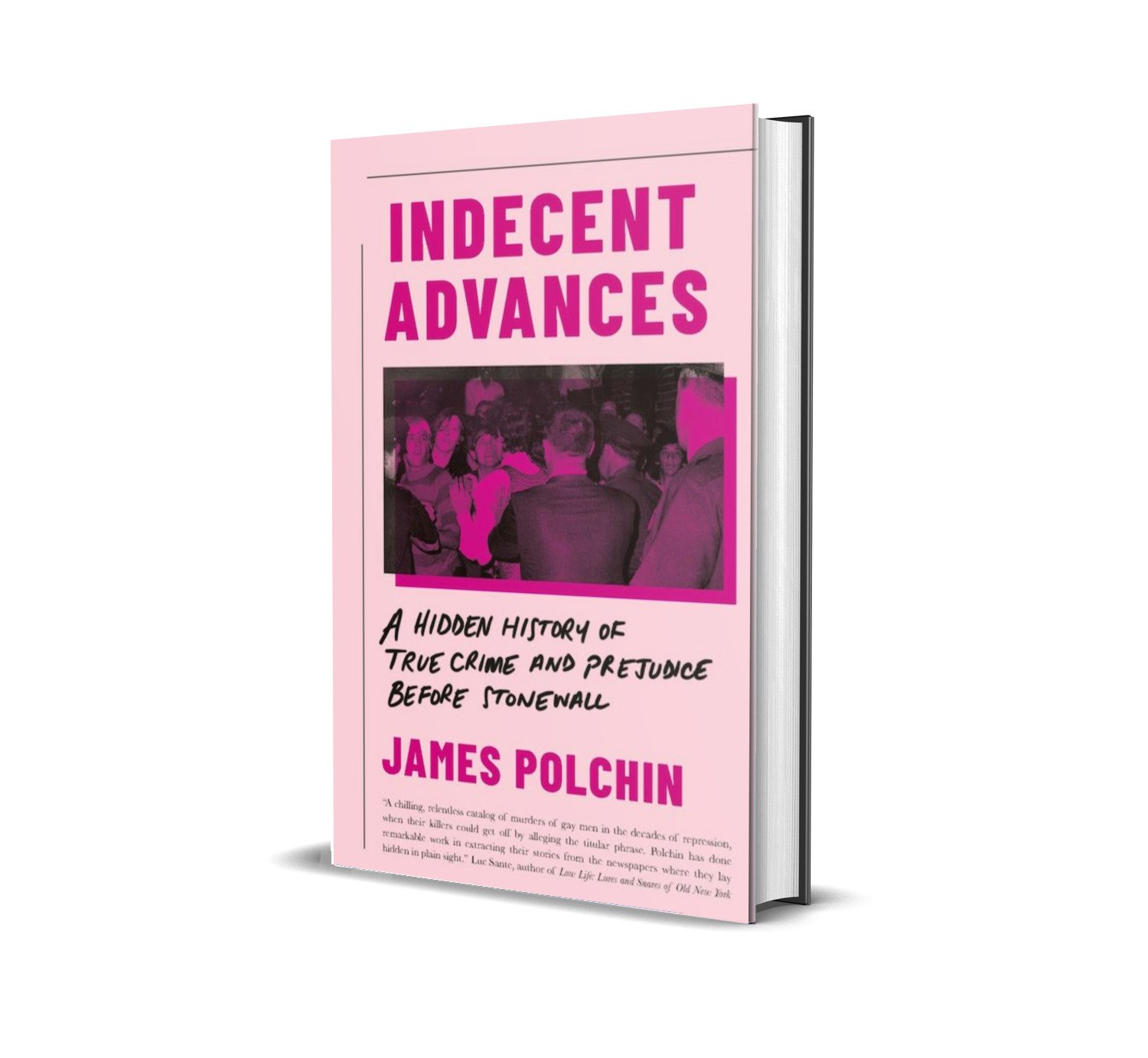
A skillful hybrid of true crime and social history that examines the relationship between the media and popular culture in the portrayal of crimes against queer men in the decades before Stonewall.
Stories of murder have never been just about killers and victims. Instead, crime stories take the shape of their times and reflect cultural notions and prejudices. In Indecent Advances, James Polchin recovers and recounts queer stories from the crime pages—often lurid and euphemistic—that reveal the hidden history of violence against queer men.
What was left unsaid in the crime pages provides insight into the figure of the queer man as both criminal and victim, offering readers tales of vice and violence that aligned gender and sexual deviance with tragic, gruesome endings. Victims were often reported as having made “indecent advances,” forcing the accused’s hands in self-defense and reducing murder charges to manslaughter.
Published in time for the fiftieth anniversary of the Stonewall uprising on June 28, 1969, Indecent Advances investigates how queer men navigated a society that criminalized them and displayed little compassion for the violence they endured. Polchin shows, with masterful insight, how this discrimination was ultimately transformed by activists to help shape the burgeoning gay rights movement in the years leading up to Stonewall.
Praise for Indecent Advances
“To shed light on these killings, the social conditions and psychological conflicts that gave rise to them, and the manipulative and sensationalist coverage that they often received in the press, the cultural historian James Polchin has written Indecent Advances, a grisly, sobering, comprehensively researched new history. The subject matter doesn’t make for light reading; Polchin admits to feeling ‘haunted’ by what he discovered in archives. But it’s impossible to understand gay life in twentieth-century America without reckoning with the dark stories. Gay men were unable to shake free of them until they figured out how to tell the stories themselves, in a new way.”
Caleb Cain, The New Yorker
“[A] fascinating new book on the treatment of gay men in true crime and crime fiction reexamines the violence that people at the Stonewall Inn had faced every day, and the rage crackling up underneath.”
Alexander Chee, New Republic
“Indecent Advances collects and rescues significant gay history and goes a long way toward clarifying why we fight, what we fight for and how prejudice is an historically institutional force.”
Tom Cardamone, Lambda Literary
“For readers searching for a fast-paced, meticulously researched, thoroughly engaging (and often infuriating) look-see into the systematic criminalization of gay men and widespread condemnation of homosexuality post-World War I, cultural historian James Polchin’s first book, Indecent Advances: A Hidden History of True Crime and Prejudice Before Stonewall, is a smart bet.”
Alexis Burling, San Francisco Chronicle
“Polchin recounts the cases as a series of short thrillers organized by decade through the 20th century. These true stories remain suspenseful episodes of surprising brutality and sensationalized press. Polchin pays scholarly attention to the politics of each era, and tales that were once grisly exploitation of murder victims become tense examinations of journalism and detective work.”
Devlyn Camp, Chicago Reader
“Indecent Advances is a significant contribution to queer history and to understanding the forces that shape contemporary queer identity.”
Michael Nava, Los Angeles Review of Books
“James Polchin’s “Indecent Advances” tells the grim tale. Advertised as “A Hidden History of True Crime and Prejudice Before Stonewall,” it focuses on what it meant to be a gay man in the first half of the 20th century: A target.”
Jacqueline Cutler, New York Daily News
“A bevy of books were published timed for the 50th anniversary of Stonewall but few as fascinating and maddening as Indecent Advances: A Hidden History of True Crime and Prejudice Before Stonewall. In it, James Polchin uncovers queer stories from the crime pages, sensationalized, lurid, euphemistic — that show how violence against gay and bisexual men was often blamed on the victim’s gender and sexual “deviance,” letting the killers off scot-free.
Diane Anderson-Minshall, Advocate
“Beginning in the years before the Stonewall Riots, Indecent Advances: A Hidden History of True Crime and Prejudice Before Stonewall by James Polchin takes a look at the crimes committed against gay men, long before equality and rights were a notion, let alone even being on the table. Murder, of course, lines the pages of this book but you’ll also read stories of harassment, assault and minor crimes that were embellished so that they could be charged as more serious. Polchin also looks at how criminal acts committed by and aimed at LGBT people came under controversy when attention was paid to one minority group’s safety and not to that of another group. This, the embedded presence of many (in)famous criminals, and other stories lightly linked to Stonewall make it an interesting book.”
Washington Blade
“[A] harrowing account of the history of violence against queer men . . . It’s perfect timing for a book that dives deep into these never-before-told true crimes, and looks at the power mainstream messaging had on both the violence and the mounting resistance. Resurrecting a forgotten era of queer history, Polchin masterfully weaves brutal true crime research with critical analysis of the social history, exploring the way the media and nascent psychological theories were weaponizing prejudice and perpetuating a deviant stereotype of gay men.”
Crime Reads, One of the Most Anticipated Crime Books of the Summer
“Resurrecting a forgotten era of queer history, Polchin masterfully weaves brutal true crime research with critical analysis of the social history, exploring the way the media and nascent psychological theories were weaponizing prejudice and perpetuating a deviant stereotype of gay men.”
Camille LeBlanc, Literary Hub, One of the Most Anticipated Books of the Summer
“Polchin’s deep dive into the history leading up to the riots underscores the difficulty of telling a story that’s so bound up in myth—and the importance of doing it anyway . . . Polchin pulls the lives out of the archives with relentless precision in his book. The particularity of Polchin’s accounts restores some honor to the memory of the men whose brutal stories tell.”
Jason Tougaw, Electric Literature
“James Polchin has written an important book about a critical chapter of LGBT history, carefully documenting the victimization and discrimination that gay men suffered before Stonewall.”
Bill Burton, Gay and Lesbian Review
"Thoughtful, accessible and well-researched, Polchin's book offers useful insight into some of the lesser-known cultural currents that gave rise to the gay rights movement. An enlighteningly provocative cultural history."
Kirkus Reviews
“He looks at cultural trends, such as the courtroom defense of “acute homosexual panic” in response to “indecent advances” from the victim, but also digs deeply into individual high-profile cases, often quoting the most lurid details from the original reporting, which will likely delight true crime fans and satisfy academics but deeply disturb other readers.”
Publishers Weekly
“James Polchin wants us to have the specifics. His book Indecent Advances, published this month by Counterpoint, collects and analyzes news reports of gay-related crime from the 1920s to the 1960s. The result is an act of witnessing that will reconfigure anyone who came of age after Stonewall. Once we know all this, we have to reckon differently with our country . . . It’s almost unbearable to see this pattern of shame and violence so clearly laid out. How do we cope with these victims, who were only guilty of trying to exist? How do we accept that many of these murderers seem to have been gay men themselves, warped by self-loathing until they massacred their own? It’s beyond weeping. To his credit, Polchin never commands us to weep. His writing is unvarnished and unsentimental as he takes us chronologically through these decades of crime, and when the facts need context, he clearly explains how scientific, religious, and political forces of the time helped endorse these murders. And while there are moments when he allows himself some tart editorializing, he doesn’t linger over his own outrage. Instead, he trusts the details will make us angry on their own. In his wallop of a conclusion, though, Polchin does describe being haunted by his own research, as well as being deeply moved.”
Mark Blankenship, The Blotter
"Polchin’s extraordinarily well-researched account offers a valuable contribution to both social and previously neglected gay history."
Booklist
“Polchin (liberal studies, New York Univ.) presents a reflective, thoughtful first book that perfectly blends true crime and the history of discrimination against gay men in the 20th century . . . His insightful history of crimes perpetrated against gay men is essential for social history fans. Readers who enjoy well-researched, deliberate social commentary will appreciate Polchin’s enlightening and descriptive style.”
Library Journal(starred review)
“Excerpts from sources as stylistically disparate as tabloids, texts, novels, and the Physicians’ Desk Reference . . . enrich the scope of the book’s analysis to an extent otherwise impossible . . . Whether large or small, many of these stories function like mirrors, reflecting light onto one another or reflecting nearly identical images from today. James Polchin’s Indecent Advances inspires further exploration into the hidden histories of marginalized populations and how the violence they suffer might be the result of a system that excludes some people from its protections, exiling them to places where they are made more vulnerable.”
Linda Thorkalson, Foreword Reviews
“Compact and powerful, Polchin’s social history of crimes against queer men in the first half of the 20th century coincides with the 50th anniversary of the Stonewall Riots in New York City. An important book for an important anniversary . . . Required reading. Highly recommended.”
Sarah Hendess, Historical Novel Society
“Indecent Advances is a chilling, relentless catalog of murders of gay men in the decades of repression, when their killers could get off by alleging the titular phrase. James Polchin has done remarkable work in extracting their stories from the newspapers where they lay hidden in plain sight.”
Luc Sante, author of Low Life: Lures and Snare of Old New York
“It is tempting to think of James Polchin’s Indecent Advances as the first noir queer history of the twentieth century. Its fascinating, vivid, case-by-case survey of violent crimes committed against gay men reads like a page turning clash of tabloid headlines and pulp fiction. Yet, beneath this shocking, unfolding narrative is a beautifully written, deeply researched examination of how this violence has been institutionalized, accepted, and excused. Polchin’s detective work on the crimes is thrilling – news stories, police reports, trial excerpts – and his decade by decade contextualization is astute and compelling. This is a history that has been waiting to be written, a splendid narrative that grips the reader as it illuminates its subject.”
Michael Bronski, author of A Queer History of the United States
"James Polchin has written a vital, masterful corrective on American sex crime that redefines who was the criminal. In Indecent Advances, it was often the arresting agents and biased reporters who conspired to abuse the rule of law. Polchin skewers the triumphalist narrative of LGBT+ rights – the notion of a long march to freedom – by excavating a lost record of atrocities. Ray Bradbury would call this ‘the terrible tyranny of the majority’ against a minority group. This book reveals, existentially, why queer Americans had to rise up."
Robert W. Fieseler, author of Tinderbox: The Untold Story of the Up Stairs Lounge Fire and the Rise of Gay Liberation
"Breathtaking and compelling, Indecent Advances is a history book that reads like a novel written by a historian who uncovers evidence like a detective. James Polchin rediscovers the heartbreaking stories of how gay men’s sexual desire often left them dead in empty hotel rooms. For too long, these harrowing accounts have appeared as fragments set against the backdrop of larger narratives of progress. Indecent Advances dares to say their names and to tell their stories, and refuses for them to be left dead and alone."
Jim Downs, author of Stand By Me: The Forgotten History of Gay Liberation
"In his revelatory and meticulously researched book, James Polchin has discovered a forgotten chapter of queer history hiding in plain sight: in sensationalistic newspaper articles documenting decades of antigay violence, often in coded terms. Looking at gay life through this novel lens offers an entirely fresh take on what previous generations endured. Like the best true crime stories, Indecent Advances is both brutal to read and impossible to put down."
Wayne Hoffman, author of An Older Man
"Indecent Advances is fascinating rediscovered history that reads like the best true crime murder mysteries. But, in fact, the stories it tells reveal a community under siege, a brutal era of violence against queer men in which society and the law often looked the other way."
William J. Mann, professor of LGBT history at Central Connecticut State University and author of Tinseltown: Murder, Morphine, and Madness at the Dawn of Hollywood
INDECENT ADVANCES - Excerpt
Criminalizing Queer Men
In January 1943, the thirty-one-year-old playwright Tennessee Williams wrote in his journal about the first time he was physically struck by another man:
Unhappily I can't go into details. It was a case of guilt and shame in which I was relatively the innocent party, since I merely offered entertainment, which was accepted with apparent gratitude until the untimely entrance of other parties. Feel a little sorrowful about it. So unnecessary. the sort of behavior pattern imposed by the conventional falsehoods. . . . Why do they strike us? What is our offense? We offer them a truth which they cannot bear to confess except in privacy and the dark—a truth which is inherently as bright as the morning sun. He struck me because he did what I did and his friends discovered it. Yes, it hurt—inside. I do not know if I will be able to sleep. But tomorrow I suppose the swollen face will be normal again and I will pick up the usual thread of life.
Today we might describe his companion's response as "homosexual panic," that dubious psychological condition that had its origins among sailors and soldiers returning from World War I. If Williams's attacker had been arrested for the assault, he might have claimed that Williams provoked the attack through a sexual solicitation; sodomy was then a felony punishable with prison sentences in every state in the country. In the press, editors would have reported that Williams's bruised and swollen face was a result of his "indecent advance," a euphemistic term that resonated with sexual deviancy and violence, and would have reminded readers of the specific kinds of criminal threats queer men posed to society. While the term was used to describe all manner of violent sexual assaults, editors were reticent to offer details given the journalistic standards of the day, which allowed for such references only through suggestion and innuendo.
Like many queer men of the era, Williams risked police arrests or attacks by would-be robbers while he went in search of sexual and social encounters on the margins of the city—along the docks, parks, and street corners where such encounters could be had. A few weeks after that initial violent incident, Williams would have another encounter that verged on the edge of violence. This time, it was not a case of homosexual panic, but rather one of intended intimidation and robbery. The man he brought back to his room began insulting and bullying Williams, threatening him with physical violence as he rummaged through his things. The experience "carried on for about an hour," Williams wrote, and while he remained calm, he was fearful that his abuser would steal or destroy his manuscripts. Williams wrote: "He finally despaired of finding any portable property of value and left, with the threat that any time he saw me he would kill me. I felt sick and disgusted. I think that is the end of my traffic with such characters." While this encounter lacked the physical violence of the earlier incident, it clearly had a stronger effect on Williams emotionally. The man's threats of future violence, and even murder, stiffened him to the dangers of such encounters. Williams did not report either incident to the police, for to do so in 1943 would risk his own arrest for sodomy, disorderly conduct, or some other criminal offense. The next day in his journal, he described the night as "the most shocking experience I've ever had with another human being."
Williams's two encounters, which left him with physical and emotional injuries, were fueled as much by the era's social prejudices as by a long history of criminalizing queer men, making them vulnerable targets for violence and abuse. "The history of Western representation is littered with the corpses of gender and sexual deviants," writes the critic Heather Love. Queer history has often focused on narratives of progress in which sexual minorities prosper despite the social injuries done to them. This progressive and affirmative narrative has made injury and violence historical realities we often write against, through an emphasis on community building, cultural expressions, and political activism. Sexual minorities survived and flourished, the story goes, despite all they had to endure. But there is another story of queer experience, one that tries to recover encounters much deadlier than the ones Williams recorded in his journal. "Modern homosexual identity is formed out of and in relation to the experience of social damage," Love argues, adding, "paying attention to what was difficult in the past may tell us how far we have come, but that is not all it will tell us; it also makes visible the damage that we live with in the present."
This book offers one way into this record of such damage by recovering a lost history of queer true crime stories published in the press between World War I and the Stonewall protests of 1969. Most of these stories have never been read since their original publication; their documentation of injustices and discrimination has been buried for decades. In these stories, we encounter men found stabbed, shot, or strangled in hotel rooms, apartments, public parks, and subway bathrooms. We witness accounts of brutal violence between roommates, sailors and civilians, young men and older men, working-class men and wealthy companions. Many of the victims were married men, living their sexual lives in secret rendezvous, under false names to hide their identities. Others were clearly living as homosexual men, single or partnered, participating in the queer worlds that were emerging in many cities across the country with increasing visibility. Not surprisingly, such crime reports were mostly stories about encounters between white men. When men of color were present in the mainstream press, they were usually, if not always, the killers of the white men they met, reflecting how the crime pages embodied the broader racial segregation of the times.
In returning to these long-forgotten stories, we see how newspaper editors and writers shaped the human dramas with sensational appeal and cautionary concerns, furthering the era's focus on the salacious and entertaining elements of crime. Not only did the press educate readers about the nature of crime and violence, giving insights into police investigations and the courtroom battles, it also reflected and shaped ideas of morality and immorality, particularly as homosexuality was increasingly a subject of public concern. In an era when queers were understood as despised criminals, the press did much to fan the fears about sexual deviancy with sensational headlines, suggestive details, and shocking accounts of crime scenes. Such fears were acutely evident in numerous sex crime panics, frenzied moments where violent crimes that simmered with a sexual undertone became front-page news, pointing readers to the problems of sexual deviants and often targeting homosexuals for increased arrests, vigilante violence, and new efforts to criminalize harmless sexual behaviors. While queer true crime stories reflected and amplified social prejudices and state-sanctioned discriminations, they also show us how queer men were forced to navigate such dangers in their search for sexual adventure and social life.
While readers encountered queer true crime stories in scandalous front-page headlines, they also found them in smaller, more mysterious accounts. Just a few months after Williams recorded his violent encounters in his journal, The New York Times published this account in its evening edition about the mysterious and fatal incident between two men in a rooming house on Manhattan's west side:
A slightly built middle-aged man who registered yesterday afternoon at a rooming house on 608 Eighth Avenue with a sailor as a companion, was found dead in his room there an hour later, with his skull shattered. He had been stripped of his suit by the sailor who disappeared. The civilian had registered at the rooming house as Harry Bowen of New York City, and his companion, about 19 years old, who was in the naval uniform, as C. E. Bowen. Shortly after they had gone to their room the sailor reappeared, carrying the older man's suit, and left the house. Mrs. Rebecca Seligsohn, the housekeeper, decided to investigate and found the sailor's roommate dead.
Buried on the bottom half of page thirty-eight, this was the entire article about the crime. The next day, the paper revealed "the elderly man found beaten to death Saturday afternoon" had used a false name. The murder victim was not Harry Bowen, but rather Charles Patterson, a sixty-nine-year-old postal worker who lived in the leafy suburban town of Summit, New Jersey, with his wife, Adelaide, in a large nineteenth-century Dutch colonial in the center of town.
Patterson had taken the train into Manhattan to buy theater tickets to celebrate his upcoming forty-seventh wedding anniversary the following week. At some point he met a sailor—or a man dressed in a sailor uniform—and found his way to the rooming house just a few blocks from Bryant Park, an area known for its vagrants and queer cruising in the 1930s and 1940s. There the two men registered with oddly similar names, suggesting they might have pretended to be related to avoid problems with the manager. The mysterious details of the encounter were central to press reports as they circulated through the Associated Press wire service to newspapers in New Jersey and Delaware. Readers learned that Patterson was found "half-clothed," and that police were searching for a "young, blond sailor." But after the few initial stories, and, apparently, no real leads in the case, the crime disappeared from the newspapers.
Many readers in the 1940s would have understood the sexual undertones of the crime that seem so apparent to us today. While a married man meeting a younger man in public and renting a hotel room together under assumed names may not easily fit into the history of queer experience, it is undeniably a part of that history. The press found in Patterson's murder a familiar tragedy of urban crime, with a thinly veiled subtext of sexual deviance that coupled homosexuality with criminality. Although Patterson's murder is horrific to us today, not only for its brutality but also for how the queer victim was targeted for robbery by the younger assailant, in 1943 Patterson's harmless search for a sexual encounter with another man would have been considered a felony, punishable with harsh sentencing. While his murder was shocking, what led him into that hotel room with the younger man would have been equally appalling and criminal.
Even when they suffered such violence, queer men in the courts and the press were not always understood as victims. How the press defined these queer true crime stories—who were the victims and who were the criminals—was set within a constellation of cultural values, journalistic ethics, and political trends. In this sense, queer true crime stories give us much more than compelling headlines of dramatic and horrifying tales of murder and assaults. They also show us how violence and prejudice can take hold when you criminalize a group of people, harness the expertise of the medical and legal professions and circulate these ideas through the press. Order now on Amazon, Audible, BookShop.org, or Barnes&Noble.